Coordination: Dr. Markus Eidemüller (formerly: Dr. Peter Jacob)
Radiation therapy for breast cancer patients reduces the recurrence of the tumor and increases their chances of additional years of life. However, there is some likelihood of other tumors or heart disease occurring later in life due to the radiation exposure.
Due to the improved cure rates and longer survival of patients, these radiation-induced long-term risks are becoming a focus of research. Radiation doses in nearby as well as more distant organs strongly depend on the radiation technique as well as the individual patient. In order to estimate personalized long-term risks, this dosimetric information must be combined with appropriate mathematical models for radiation-induced cancer and heart disease.
In breast cancer radiotherapy, the affected breast is usually irradiated homogeneously, with an additional boost to the tumor bed. Organs in the immediate vicinity of the affected breast (heart, lung, contralateral breast) receive very high doses with steep dose gradients. The dose distribution in these organs may depend strongly not only on the applied method, but also on the anatomy of the patients. Furthermore, the more distant organs may also receive substantial doses that are highly dependent on technique and poorly classified. In PASSOS, a systematic characterization of the exposure of nearby and distant organs was performed.
Models of radiation risk after breast cancer radiotherapy have been developed for various cancers as well as for heart disease. Due to the extreme dose range, especially for the heart, lung and contralateral breast, risk estimates based on radiotherapy studies are combined with estimates from radiation epidemiology studies of the low and intermediate dose range. Furthermore, individual risk factors, such as age, smoking, and tumor status, are considered.
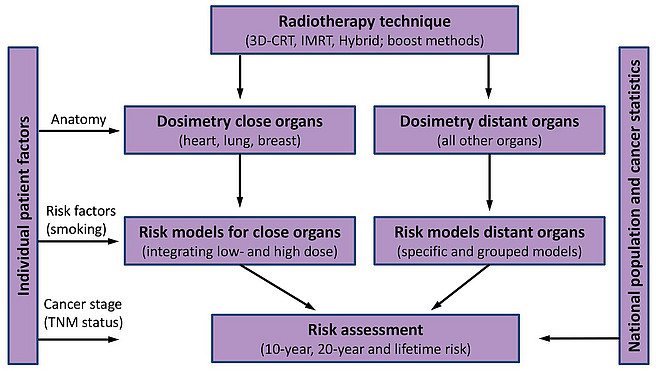
Figure 1 gives an overview of the methodology used. The PASSOS software combines the dosimetric information with the risk models and can calculate spontaneous and radiation-induced long-term risks for different types of cancer and for heart disease. The long-term risks are given for different times after radiotherapy, such as after 15 years or until the age of 80 years.
Due to the improved cure rates and longer survival of patients, these radiation-induced long-term risks are becoming a focus of research. Radiation doses in nearby as well as more distant organs strongly depend on the radiation technique as well as the individual patient. In order to estimate personalized long-term risks, this dosimetric information must be combined with appropriate mathematical models for radiation-induced cancer and heart disease.
In breast cancer radiotherapy, the affected breast is usually irradiated homogeneously, with an additional boost to the tumor bed. Organs in the immediate vicinity of the affected breast (heart, lung, contralateral breast) receive very high doses with steep dose gradients. The dose distribution in these organs may depend strongly not only on the applied method, but also on the anatomy of the patients. Furthermore, the more distant organs may also receive substantial doses that are highly dependent on technique and poorly classified. In PASSOS, a systematic characterization of the exposure of nearby and distant organs was performed.
Models of radiation risk after breast cancer radiotherapy have been developed for various cancers as well as for heart disease. Due to the extreme dose range, especially for the heart, lung and contralateral breast, risk estimates based on radiotherapy studies are combined with estimates from radiation epidemiology studies of the low and intermediate dose range. Furthermore, individual risk factors, such as age, smoking, and tumor status, are considered.
Figure 1 gives an overview of the methodology used. The PASSOS software combines the dosimetric information with the risk models and can calculate spontaneous and radiation-induced long-term risks for different types of cancer and for heart disease. The long-term risks are given for different times after radiotherapy, such as after 15 years or until the age of 80 years.
Current further developments (as of November 2023:
• Currently, the software is being further developed to allow the user to read dose distributions into the software either via ASCII files or as DICOM format
•The user interface is to be revised and adapted to clinical needs
• Improved personalization of risk assessments
Partner:
Institut für Medizinische Biometrie, Epidemiologie und Informatik, Johannes-Gutenberg Universität Mainz
Klinik und Poliklinik für Radioonkologie und Strahlentherapie, Johannes-Gutenberg Universität Mainz
Klinik für Strahlentherapie und Radioonkologie, Universitätsklinikum Ulm
Nuklearmedizinische Klinik und Poliklinik, Technische Universität München
Klinik und Poliklinik für Strahlentherapie, Universität Rostock
Klinik für Strahlentherapie und Radioonkologie, Universitätsklinikum Leipzig
Institut für Strahlenmedizin, Helmholtz Zentrum München
Contact:
Heart Study and Dosimetry:
PD Dr. Daniel Wollschläger, Institut für Medizinische Biometrie, Epidemiologie und Informatik, Johannes-Gutenberg Universität Mainz
wollschlaeger@uni-mainz.de
Risk assessment and Software:
Dr. Markus Eidemüller (Coordinator), Bundesamt für Strahlenschutz (BfS)
meidemueller@bfs.de
Download Software:
Link to Software-download
Publications:
Link to Publication list (PDF 153,9 KB)
• Currently, the software is being further developed to allow the user to read dose distributions into the software either via ASCII files or as DICOM format
•The user interface is to be revised and adapted to clinical needs
• Improved personalization of risk assessments
Partner:
Institut für Medizinische Biometrie, Epidemiologie und Informatik, Johannes-Gutenberg Universität Mainz
Klinik und Poliklinik für Radioonkologie und Strahlentherapie, Johannes-Gutenberg Universität Mainz
Klinik für Strahlentherapie und Radioonkologie, Universitätsklinikum Ulm
Nuklearmedizinische Klinik und Poliklinik, Technische Universität München
Klinik und Poliklinik für Strahlentherapie, Universität Rostock
Klinik für Strahlentherapie und Radioonkologie, Universitätsklinikum Leipzig
Institut für Strahlenmedizin, Helmholtz Zentrum München
Contact:
Heart Study and Dosimetry:
PD Dr. Daniel Wollschläger, Institut für Medizinische Biometrie, Epidemiologie und Informatik, Johannes-Gutenberg Universität Mainz
wollschlaeger@uni-mainz.de
Risk assessment and Software:
Dr. Markus Eidemüller (Coordinator), Bundesamt für Strahlenschutz (BfS)
meidemueller@bfs.de
Download Software:
Link to Software-download
Publications:
Link to Publication list (PDF 153,9 KB)