The Clinical Epidemiology and Systems Medicine focuses on patient-oriented translational cardiovascular research. Its main emphasis lies on the conduct of prospective cohort studies and clinical trials aimed at improving the prevention, diagnosis, treatment, and prognosis of common diseases, particularly cardiovascular diseases. To achieve this, we pursue a holistic approach that considers all levels influencing disease development – ranging from genetics, lifestyle, and social conditions to other environmental factors.
Our Aims
Identification and understanding of clinical and subclinical phenotypes (e.g., intermediate organ damage) through the analysis of molecular patterns in human subjects with well-defined phenotypes.
Screening and prioritization of therapeutic targets by linking pathophysiological processes with clinical outcomes.
Building a bridge between the laboratory and the patient's bedside by developing molecular hypotheses that can be tested in experimental (Phase I–II) and clinical (Phase III–IV) settings.
Epidemiology
Systems Medicine
The Clinical Epidemiology and Systems Medicine (CESM) combines methods of modern systems medicine and clinical epidemiology to gain a new understanding of complex diseases. To achieve this, multiple layers of data — ranging from DNA to the transcriptome, proteome, and metabolome, as well as regulatory levels including DNA methylation — are analyzed holistically and integrated with detailed clinical phenotype data. This enables a comprehensive representation of the investigated disease within the context of the respective biological system. The goal of the transdisciplinary team of experts is to understand whether and how these processes are causally related to disease development. We use the following methods:
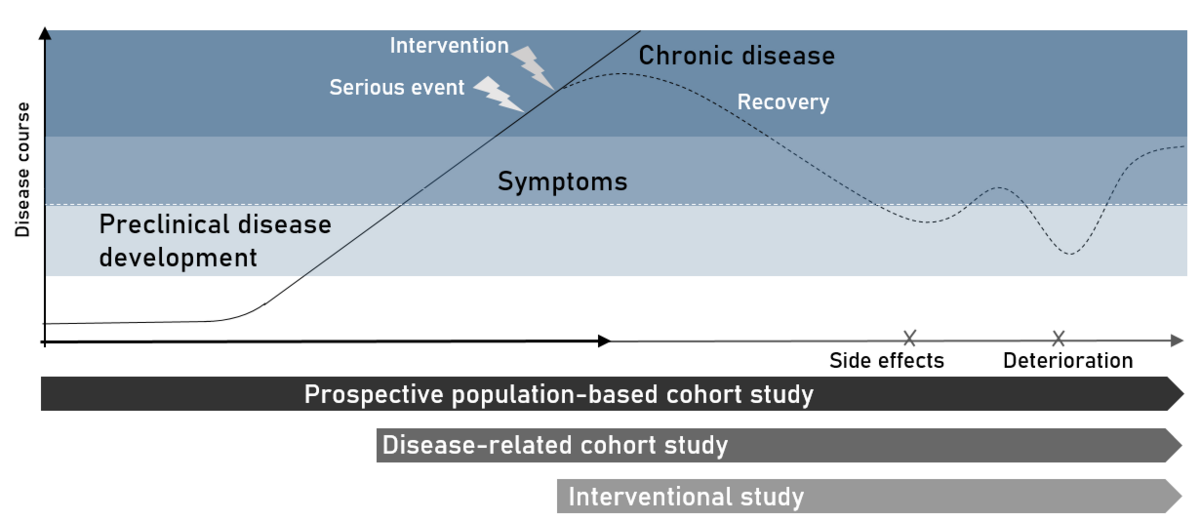
The Gutenberg cohorts of CESM (e.g. the Gutenberg Health Study, Gutenberg COVID-19 Study, and MyoVasc) are characterized by the sequential collection of biospecimens at multiple time points. Multi-omics profiling is performed on these biospecimens, and subsequent processing follows highly standardized procedures. This enables a high-resolution insight into the pathophysiology of disease across all stages — from the phase before disease onset to acute disease, its progression, and its outcome.
To support innovative systems medicine research, CESM employs statisticians and researchers dedicated to the development of novel biostatistical and machine learning methods. These methods are optimized for the specific purpose of each investigation, whether for drug target discovery, mechanistic exploration of pathway involvement, monitoring disease progression over time, or integrative multi-omics approaches that also include less well-characterized data layers such as the lipidome.
Across all applications, it is essential that key characteristics of the biological system under investigation are adequately captured, including non-linear relationships, interactions, and clustering structures (e.g. based on shared pathways, functions, or sequence homology). To meet these challenges in extremely high-dimensional settings, new methods are continuously being developed and implemented.
Large amounts of clinical imaging data are generated daily in hospitals. Despite recent advances, only a small fraction of these data are currently utilized for clinical or research applications. New developments in artificial intelligence (AI), particularly in the field of deep learning, offer the opportunity to unlock the vast potential of this largely untapped resource. Researchers and staff at CESM collaborate on optimizing deep-learning architectures for the automation and enhancement of clinical imaging pipelines, as well as on the extraction of novel features that may improve and accelerate individualized risk prediction.
Interested in our research?
Here you can find further information on our studies, publications, and scientific focus areas.