Research Group Falter – Thrombotic microangiopathies
Background
Thrombotic microangiopathies (TMA) comprise a group of diseases with very heterogeneous etiologies, including thrombotic thrombocytopenic purpura (TTP), a rare, potentially life-threatening disease that presents as acute, often recurrent episodes. TTP is caused by a deficiency of the von Willebrand factor (VWF)-cleaving protease, ADAMTS13, which may be due to autoantibodies or genetic factors. This results in VWF- platelet-rich microthrombi in arterioles and capillaries, leading to ischaemia of varying severity in the affected organ.
Typically, TTP affects the brain, with associated neurological abnormalities, but renal dysfunction, cardiac symptoms and ischaemia in other organs may also occur.
Projects
Project 1
Studies on pathophysiology of idiopathic thrombotic thrombocytopenic purpura, particularly acute episodes was well as on potential predictive markers of acute bouts
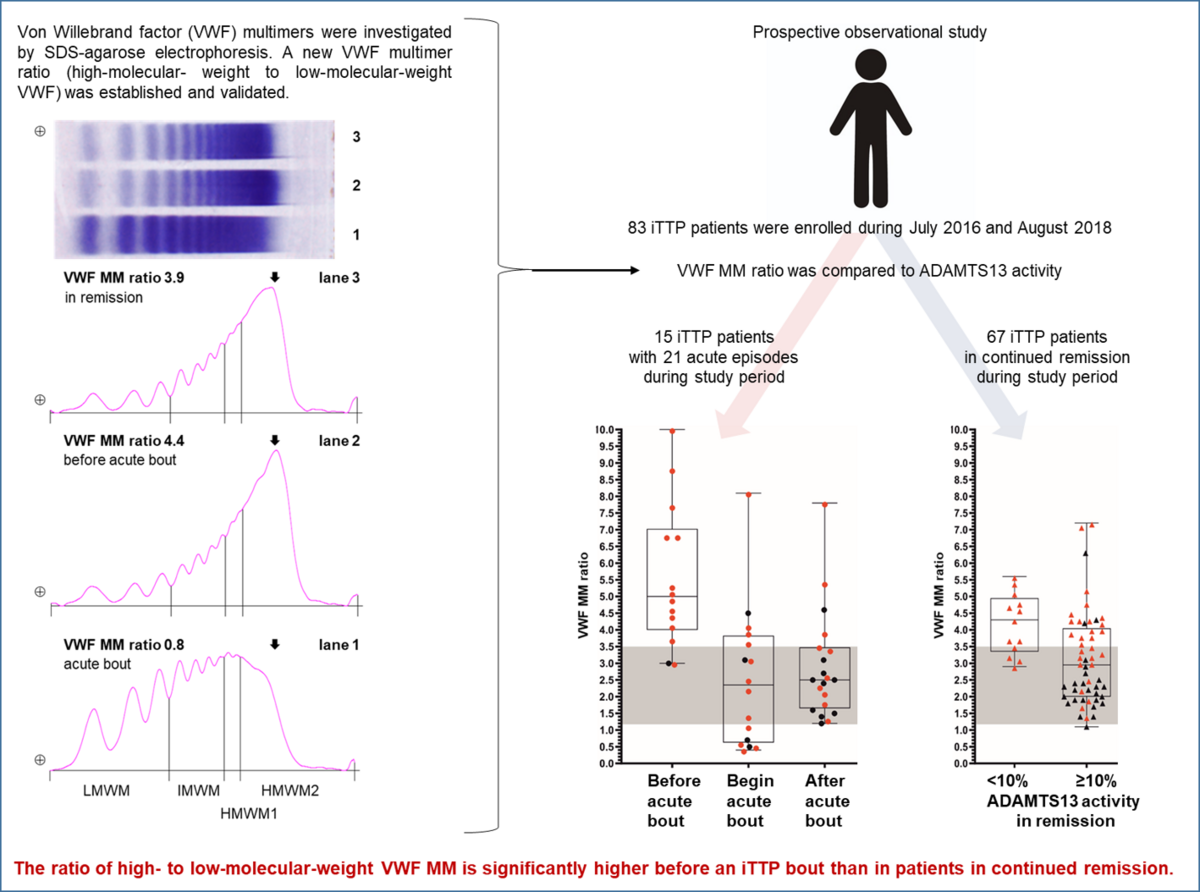
In various retrospective and prospective studies, we have investigated the frequency and severity of acute episodes and tried to identify potential predictive markers for the morbidity and mortality associated with an acute episode as well as with TTP relapse.
In this context, in collaboration with the Laboratory of Thrombosis Research (KU Leuven Campus Kulak, Belgium), we have carried out novel analyses of the conformation of ADAMTS13 before, during and after the acute bout. Furthermore, we have conducted extensive investigations into numerous laboratory diagnostic parameters, such as the complement system, troponin I and the VWF multimer pattern.
Project 2
Depression, anxiety, and neurocognitive deficits as long-term consequences of thrombotic thrombocytopenic purpura
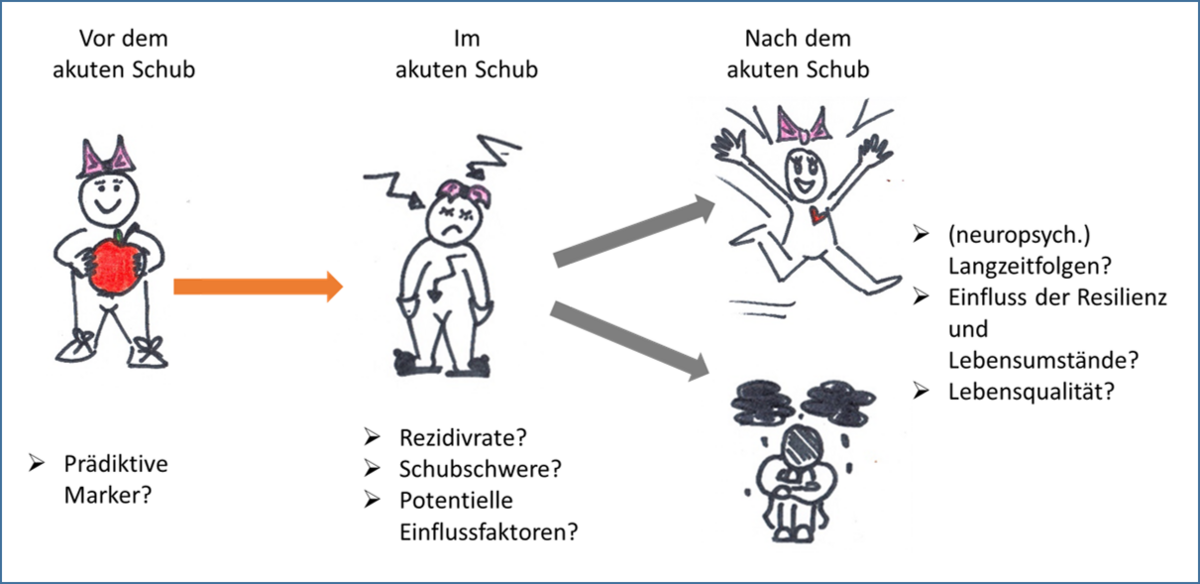
Thrombotic thrombocytopenic purpura (TTP) is a potentially life-threatening, relapsing disease in which an acquired deficiency of the enzyme ADAMTS-13 leads to generalized microvascular thrombosis in various organs, particularly the brain. As soon as the laboratory parameters return to normal after a relapse, the patient is often regarded as cured, but lives with the risk of suffering an acute relapse at any time. So far, there have been few studies on the long-term psychological and neurocognitive consequences of TTP.
We aim to investigate, through multi-year prospective questionnaire studies, the extent to which there are risks of persistent neurocognitive impairment, the need for rehabilitation, depression and anxiety following recurrent idiopathic TTP.
Project 3
The role of ADAMTS13 on liver transplantation (LTX)
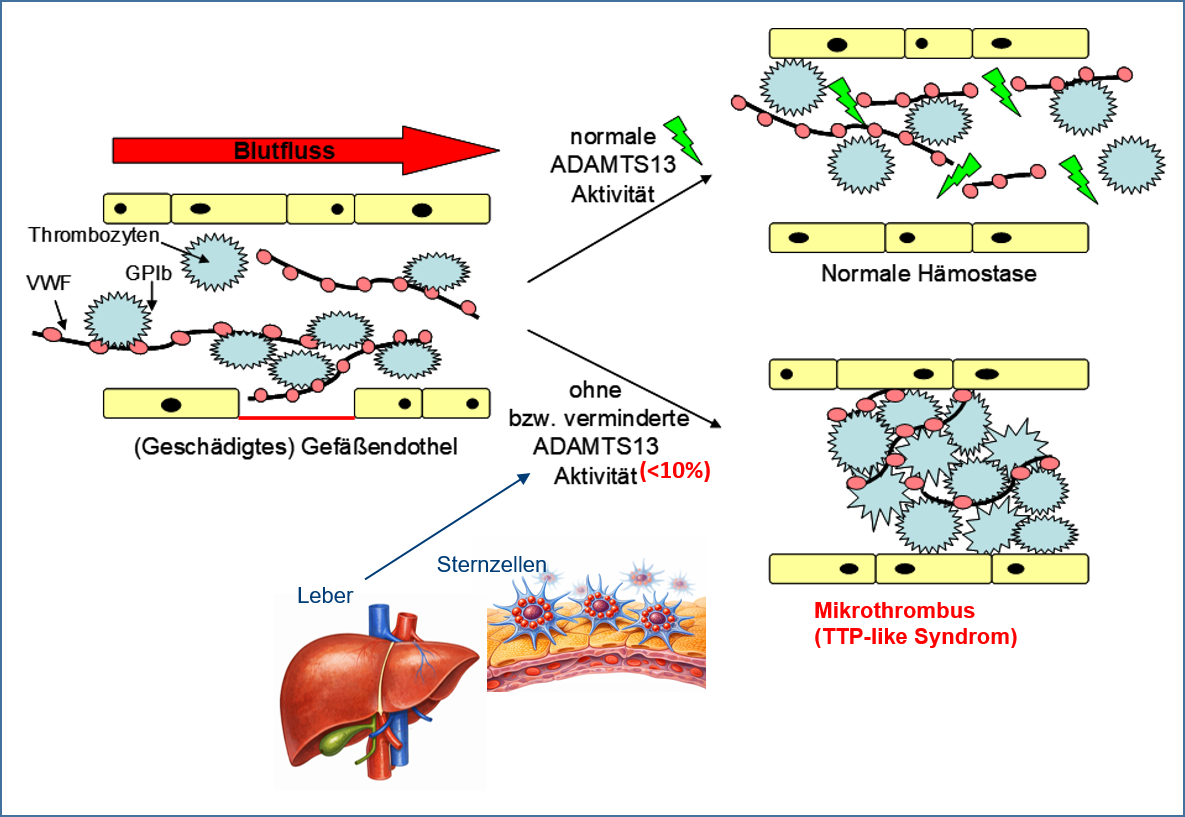
The liver plays a central role in the promotion and regulation of hemostasis. The VWF-cleaving protease - ADAMTS13 - is mainly produced by hepatic stellate cells. Deficiency of ADAMTS13 activity results in accumulation of unusually large VWF multimers, leading to platelet adhesion and aggregation in the microvasculature and organ ischemia causing thrombotic microangiopathy (TMA).
The aim of this study was to characterize the effect of liver transplantation (LTX) on ADAMTS13 activity and ADAMTS13 antigen. Furthermore, we aimed to detect and treat potentially occurring thrombotic microangiopathy (TMA) in liver transplant patients at an early stage.
Publications
- Falter T, Rossmann H, de Waele L, et al. A novel von Willebrand factor multimer ratio as marker of disease activity in thrombotic thrombocytopenic purpura. Blood Adv. 2023;7(17):5091-5102. doi:10.1182/bloodadvances.2023010028
- Kangro K, Roose E, Joly BS, et al. Anti-ADAMTS13 autoantibody profiling in patients with immune-mediated thrombotic thrombocytopenic purpura. Blood Adv. 2021;5(17):3427-3435. doi:10.1182/bloodadvances.2020004172
- Falter T, Rossmann H, Menge P, et al. No Evidence for Classic Thrombotic Microangiopathy in COVID-19. J Clin Med. 2021;10(4):671. Published 2021 Feb 9. doi:10.3390/jcm10040671
- Falter T, Böschen S, Schepers M, et al. Influence of Personality, Resilience and Life Conditions on Depression and Anxiety in 104 Patients Having Survived Acute Autoimmune Thrombotic Thrombocytopenic Purpura. J Clin Med. 2021;10(2):365. Published 2021 Jan 19. doi:10.3390/jcm10020365
- Velásquez Pereira LC, Roose E, Graça NAG, et al. Immunogenic hotspots in the spacer domain of ADAMTS13 in immune-mediated thrombotic thrombocytopenic purpura. J Thromb Haemost. 2021;19(2):478-488. doi:10.1111/jth.15170
- Roose E, Schelpe AS, Tellier E, et al. Open ADAMTS13, induced by antibodies, is a biomarker for subclinical immune-mediated thrombotic thrombocytopenic purpura. Blood. 2020;136(3):353-361. doi:10.1182/blood.2019004221
- Falter T, Herold S, Weyer-Elberich V, et al. Relapse Rate in Survivors of Acute Autoimmune Thrombotic Thrombocytopenic Purpura Treated with or without Rituximab. Thromb Haemost. 2018;118(10):1743-1751. doi:10.1055/s-0038-1668545
- Müller-Calleja N, Ritter S, Hollerbach A, Falter T, Lackner KJ, Ruf W. Complement C5 but not C3 is expendable for tissue factor activation by cofactor-independent antiphospholipid antibodies. Blood Adv. 2018;2(9):979-986. doi:10.1182/bloodadvances.2018017095
- Falter T, Schmitt V, Herold S, et al. Depression and cognitive deficits as long-term consequences of thrombotic thrombocytopenic purpura. Transfusion. 2017;57(5):1152-1162. doi:10.1111/trf.14060
- Falter T, Alber KJ, Scharrer I. Long term outcome and sequelae in patients after acute thrombotic thrombocytopenic purpura episodes. Hamostaseologie. 2013;33(2):113-120. doi:10.5482/HAMO-12-11-0019
Other publications by PD Dr. rer nat. Tanja Falter
Research Group Leader

PD Dr. rer. nat. Tanja Falter
Research Group Members

Moritz Büsgen
Student (PJ, Pharmazie)
Katharina Griem
Topic: Antiphospholipid syndrome
PhD Student (Medizin)
Fenna Hofsäß
Topic: Thrombotic microangiopathies in liver transplantation
PhD Student (Medizin)
Melina Kneip
Student (B.Sc. medizinische Biotechnologie)
Collaboration partner
- Prof. Dr. Bernhard Lämmle, Emeritus-Professor, CTH Unimedizin Mainz, Bern, Switzerland
- OA Dr. Jens Mittler, Leiter des Bereichs Lebertransplantation, Klinik für Allgemein-, Viszeral- und Transplantationschirurgie, Universitätsmedizin Mainz, Germany
- Prof. Dr. Kerstin Jurk, Arbeitsgruppe 'Thrombozyten Physiologie und Dysfunktion', Centrum for Thrombosis and Hemostasis, Unimedizin Mainz, Germany
- Prof. Dr. Karen Vanhoorelbeke, Laboratory for Thrombosis Research, KU Leuven, Belgium