Research Group Müller-Calleja – Antiphospholipid Antibodies
Background
Antiphospholipid antibodies (aPL) are considered to trigger antiphospholipid syndrome (APS), an autoimmune disorder characterized by thrombosis and miscarriages. Despite their pathogenic role, the mechanisms leading to the development and persistence of aPL remains to be elucidated. aPL can also occur in the context of viral infections. In these cases, they are only detectable temporarily and subside once the infection abates. The objective of our research is to improve our understanding of the development of aPL, their differentiation, and the mechanisms that leads to their persistence, enabling us to identify novel, relevant diagnostic, and therapeutic approaches.
Projects
Project 1
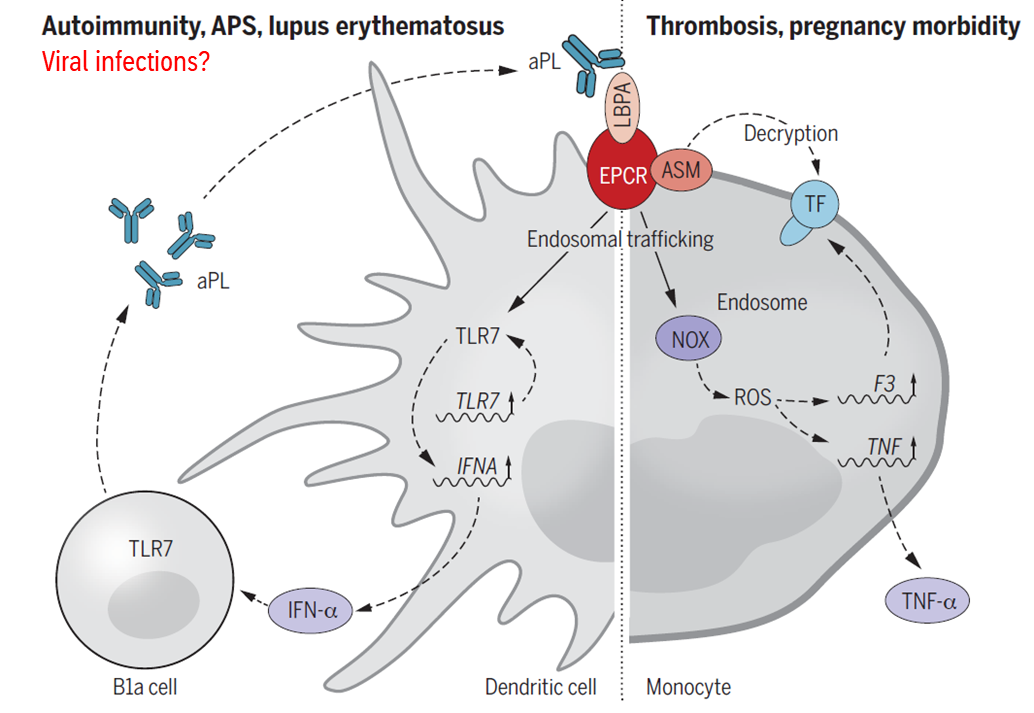
Timeline of aPL formation and signal transduction in autoimmune diseases and viral infections
In this project, we plan to expand the so far very rudimentary knowledge about the development of aPL. Based on our previous results, we will investigate the development of aPL in three different mouse models (autoimmunity, immunization with aPL, and CMV infection). In particular, we aim to examine and to compare the time course of aPL release in the context of autoimmune diseases and viral infections.
Project 2
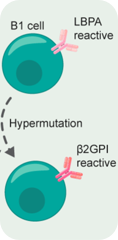
Characterization of the underlying mechanisms leading to hypermutation of aPL-producing B cells
We have shown that, in the context of both viral infections and autoimmune diseases, only lipid-reactive aPL are initially released by B1a cells. Subsequently, hypermutation of the B1a clones occurs, resulting in the formation of cross-reactive aPL that can bind to ß2GPI. We aim to elucidate the underlying mechanism using various knockout mice and pharmacological inhibitors.

Project 3
Identification of new therapeutic approaches against antiphospholipid antibodies
To improve treatment for APS patients, new therapeutic targets will be analyzed in in-vitro and in-vivo experiments. In addition to already approved drugs such as statins and hydroxychloroquine, the focus is primarily on the nematode anticoagulant protein c2 (NAPc2), which acts directly on the tissue factor signaling complex.
Publications
- Marova D, Frankenbach P, Hollerbach A, et al. Simvastatin competitively inhibits cellular signaling of lipid-binding antiphospholipid antibodies. J Thromb Haemost. 2025;23(12):3883-3894. doi:10.1016/j.jtha.2025.08.027
- Müller-Calleja N, Grunz K, Nguyen TS, et al. Targeting the tissue factor coagulation initiation complex prevents antiphospholipid antibody development. Blood. 2024;143(12):1167-1180. doi:10.1182/blood.2023022276
- Hollerbach A, Müller-Calleja N, Canisius A, Orning C, Lackner KJ. Induction of tissue factor expression by anti-β2-glycoprotein I is mediated by tumor necrosis factor α. J Thromb Thrombolysis. 2020;49(2):228-234. doi:10.1007/s11239-019-01970-2
- Müller-Calleja N, Hollerbach A, Royce J, et al. Lipid presentation by the protein C receptor links coagulation with autoimmunity. Science. 2021;371(6534):eabc0956. doi:10.1126/science.abc0956
- Müller-Calleja N, Hollerbach A, Ritter S, et al. Tissue factor pathway inhibitor primes monocytes for antiphospholipid antibody-induced thrombosis. Blood. 2019;134(14):1119-1131. doi:10.1182/blood.2019001530
- Müller-Calleja N, Ritter S, Hollerbach A, Falter T, Lackner KJ, Ruf W. Complement C5 but not C3 is expendable for tissue factor activation by cofactor-independent antiphospholipid antibodies. Blood Adv. 2018;2(9):979-986. doi:10.1182/bloodadvances.2018017095
- Müller-Calleja N, Manukyan D, Canisius A, Strand D, Lackner KJ. Hydroxychloroquine inhibits proinflammatory signalling pathways by targeting endosomal NADPH oxidase. Ann Rheum Dis. 2017;76(5):891-897. doi:10.1136/annrheumdis-2016-210012
- Müller-Calleja N, Hollerbach A, Häuser F, Canisius A, Orning C, Lackner KJ. Antiphospholipid antibody-induced cellular responses depend on epitope specificity : implications for treatment of antiphospholipid syndrome. J Thromb Haemost. 2017;15(12):2367-2376. doi:10.1111/jth.13865
- Manukyan D, Müller-Calleja N, Jäckel S, et al. Cofactor-independent human antiphospholipid antibodies induce venous thrombosis in mice. J Thromb Haemost. 2016;14(5):1011-1020. doi:10.1111/jth.13263
- Müller-Calleja N, Köhler A, Siebald B, et al. Cofactor-independent antiphospholipid antibodies activate the NLRP3-inflammasome via endosomal NADPH-oxidase: implications for the antiphospholipid syndrome. Thromb Haemost. 2015;113(5):1071-1083. doi:10.1160/TH14-07-0628
Other publications by PD Dr. rer nat. Nadine Müller-Calleja
Research Group Leader

PD Dr. rer. nat. Nadine Müller-Calleja
Research Group Members

Antje Canisius
Technische Assistentin
Paul Frankenbach
naturwissenschaftlicher Doktorand
M.Sc. Biologie

Dr. med. Dominika Marová
PostDoc
Carolin Orning
Technische Assistentin
Collaboration partner
- Prof. Dr. Wolfram Ruf, Centrum für Thrombose und Hämostase, Unimedizin Mainz
- Prof. Dr. Christoph Reinhard, Centrum für Thrombose und Hämostase, Unimedizin Mainz
- Prof. Dr. Julia Weinmann-Menke, Klinik für Nephrologie, Universitätsklinikum Heidelberg
- Prof. Dr. Luy Teyton, Scripps Research, La Jolla, USA