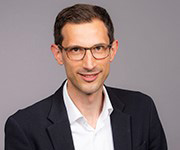
Univ.-Prof. Dr. med Michael Kühn
Emmy Noether-Research Group Investigator, Attending Physician and Head of the Acute Myeloid Leukemia Service
Research Interests
The primary focus of the laboratory is the biology and treatment of leukemia with a particular focus on acute myeloid leukemia. We are specifically interested in epigenetic alterations that control leukemogenic gene expression programs.
Our scientific efforts are committed to the development of new therapies against leukemia that are less toxic and more efficacious.

Background
Acute Myeloid Leukemia
Acute myeloid leukemia (AML) is an aggressive hematologic malignancy that is characterized by rapid cell growth and a differentiation block resulting in accumulation of abnormal hematopoietic precursor cells in the bone marrow.
The disease course is fatal in nearly all patients that are left untreated. Multi-agent chemotherapy has been the standard of care for more than 40 years but is of significant toxicity and the overall treatment outcome is still relatively unsatisfactory. These facts highlight the need for novel treatment approaches that are more specific against the leukemic cells and therefore less toxic and potentially more efficient.
Cancer Epigenetics
While all cell types in the human body such as blood, heart or brain cells share exactly the same DNA, the difference between these tissues is defined by the way they activate certain parts of the DNA. Epigenetic mechanisms control the activation or silencing of genes in different cell types. More specifically the activation or silencing of genes is determined by the way the DNA is packaged. In all human cells DNA strands are wrapped around spool-shaped proteins called histones. Chemical modifications of these histone proteins lead to activation or silencing of specific genes. DNA and histone proteins together are called chromatin and accordingly the proteins that write, read, or erase these modifications are called chromatin modifiers.
Recent research efforts revealed that mutations in chromatin regulators belong to the most commonly mutated genes in all human cancers. When changes in such chromatin regulators occur, a whole set (program) of genes can be inappropriately activated or silenced, thereby leading to cancer development. Because it has been shown that epigenetic regulators can be inhibited with drugs, many cancer researchers would agree that the main advances in cancer therapy are expected in the field of epigenetics.
Epigenetic treatment of AML
Non-selective epigenetic drugs exhibit an established treatment approach with similar efficacy as chemotherapy for specific types of leukemia. The main focus of our laboratory is to identify dependencies of AML subtypes on specific chromatin regulators that may represent novel drug targets against this deadly disease.
Current Projects
The lab is committed to the development of new therapies against leukemia that are less toxic and more efficacious. We are pursuing this goal by defining AML dependencies on specific chromatin regulators. The overarching goal is to specifically inhibit these chromatin regulators therapeutically in AML.
The menin-MLL interaction was recently shown to be a therapeutic opportunity in various genetic subtypes of AML that controls leukemogenic gene expression. In this project we are addressing detailed questions about the mechanisms involved by using CRISPR-Cas9 negative selection screens and ChIP-sequencing.

The DOT1L chromatin regulatory complex was shown to be a dependency in specific AML subtypes. In this project, we explore DOT1L functions in a broader complement of genetic AML subtypes and explore how it potentially interacts with wildtype MLL to drive leukemia.
No single drug alone is believed to cure leukemia. In this project we are developing synergistic drug combination partners for compounds that target epigenetic mechanisms in AML. Novel combinatorial drug regimens will be tested in preclinical models of various AML subtypes in vitro and in vivo.
Open Positions
We are actively searching for a highly motivated PhD-Student interested in applying cutting-edge technologies (single-cell next generation sequencing, CRISPR domain scanning, murine PDX models) to decipher disease mechanisms in leukemia.
We also welcome applications from highly motivated medical students, who aim to prepare their MD thesis in our laboratory.
For further information, please contact
Univ.-Dr. med. Michael Kühn
michael.kuehn@unimedizin-mainz.de
