

Dr. med. Daniel Sasca
Program Lead “Personalized (translational) Hematology and Oncology”, Emmy-Noether Research Group Leader, Attending Hematologist and Oncologist
Research Interests
Research group „Chromatin in tumor plasticity and resistance“
Our laboratory specializes in employing a diverse range of modern techniques in quantitative and functional genomics, as well as quantitative proteomics, with a strong emphasis on translational implications. Our primary goal is to decipher chromatin dynamics associated with cancer progression and resistance, aiming to identify means for therapeutically targeting new vulnerabilities in cancer. Our work spans across all technical facets, from molecular biology isolation/enrichment methods to library preparation, and extends subsequently to computational data processing, analysis, and integration.

Current Projects
Else-Kröner-Fresenius-Stiftung “First Grant”
Drugs targeting epigenetic modifications are promising therapies in Acute Myeloid Leukemia (AML). However, early clinical trials with compounds targeting epigenetic modifiers as single agents suggest considerable non-genetic resistance, anticipatory combination treatments becoming pivotal for better and longer disease responses. In this project, we demonstrate, track and overcome routes of AML adaptation to inhibitors of the exemplary critical transcriptional regulators termed bromodomain and extraterminal (BET) proteins.

DFG “Emmy-Noether-Program”
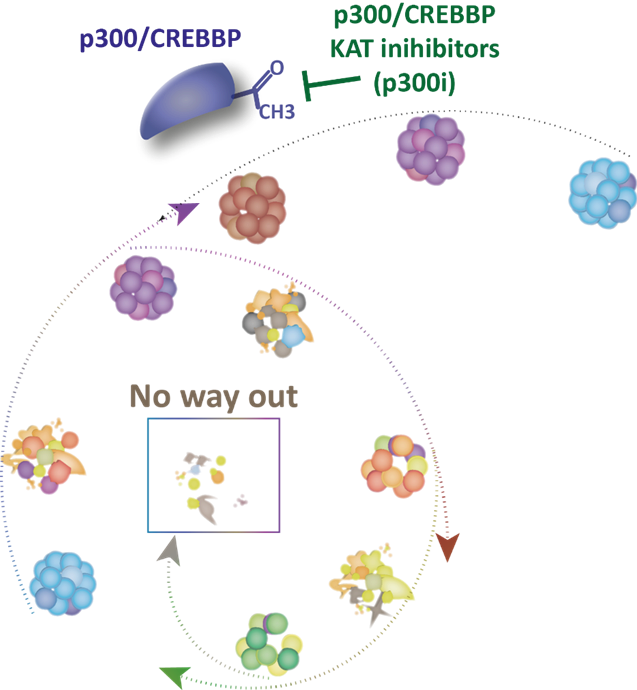
With this project, we propose that the successful clinical introduction of novel enzymatic p300/CREBBP lysine acetyltransferase (KAT) inhibitors for treating AML requires a thorough, integrative and dynamic characterization of their actions and limitations in both naïve and resistant settings. Moreover, mechanistic treatment combination strategies are required to discern between non-discriminatory increased toxicity, prevention of resistance and induction of new vulnerabilities. Additionally, we aim to demonstrate that a continuous modeling of routes and stages of resistance to epigenetic modulators is likewise an unanticipated model of treatment in AML. Considering that non-genetic resistance to treatment induces new epigenetic/transcriptional landscapes, we speculate that the rational utilization of p300/CREBBP KAT inhibitors in a sequential mechanistic combination with other epigenetic inhibitors can guide treatment trajectories in AML by gradually decreasing plasticity.
UMC Mainz “High Potentials Grant”
Loss-of-function mutations in members of the cohesin complex are recurrent events in myelodysplastic neoplasms (MDS) and acute myeloid leukemias (AML). Recently, convincing evidence has shown that cohesin deficiency leads to transcriptional dysregulation in hematopoiesis. Our preliminary data also suggest cohesin deficient cells to induce specific routes of transcriptional activation that cause myeloid disease progression. With this project, we evaluate causes and paths of cohesin deficiency-associated myeloid proliferation, both in normal hematopoiesis and in models of MDS and AML to identify opportunities to prevent myeloid cancer progression.

Selected Publications
- Sasca D, Yun H, Giotopoulos G, Szybinski J, Evan T, Wilson NK, Gerstung M, Gallipoli P, Green AR, Hills R, Russell N, Osborne CS, Papaemmanuil E, Göttgens B, Campbell P, Huntly BJP. Cohesin-dependent regulation of gene expression during differentiation is lost in Cohesin-mutated myeloid malignancies. Blood. 134 (24), 2195-2208 2019 Dec 12
- Basheer F, Giotopoulos G, Meduri E, Yun H, Mazan M, Sasca D, Gallipoli P, Marando L, Gozdecka M, Asby R, Sheppard O, Dudek M, Bullinger L, Döhner H, Dillon R, Freeman S, Ottmann O, Burnett A, Russell N, Papaemmanuil E, Hills R, Campbell P, Vassiliou GS, Huntly BJP. Contrasting requirements during disease evolution identify EZH2 as a therapeutic target in AML. J Exp Med. 2019 Apr 1;216(4):966-981. doi: 10.1084/jem.20181276. Epub 2019 Mar 19.
- Sasca D, Szybinski J, Schüler A, Shah V, Heidelberger J, Haehnel PS, Dolnik A, Kriege O, Fehr EM, Gebhardt WH, Reid G, Scholl C, Theobald M, Bullinger L, Beli P, Kindler T. NCAM1 (CD56) promotes leukemogenesis and confers drug resistance in AML. Blood. 2019 May 23;133(21):2305-2319. doi: 10.1182/blood-2018-12-889725. Epub 2019 Feb 27.
- Gallipoli P, Giotopoulos G, Tzelepis K, Costa ASH, Vohra S, Medina-Perez P, Basheer F, Marando L, Di Lisio L, Dias JML, Yun H, Sasca D, Horton SJ, Vassiliou G, Frezza C, Huntly BJP. Glutaminolysis is a metabolic dependency in FLT3ITD acute myeloid leukemia unmasked by FLT3 tyrosine kinase inhibition. Blood. 2018 Apr 12;131(15):1639-1653. doi: 10.1182/blood-2017-12-820035. Epub 2018 Feb 20.
- Horton SJ, Giotopoulos G, Yun H, Vohra S, Sheppard O, Bashford-Rogers R, Rashid M, Clipson A, Chan WI, Sasca D, Yiangou L, Osaki H, Basheer F, Gallipoli P, Burrows N, Erdem A, Sybirna A, Foerster S, Zhao W, Sustic T, Petrunkina Harrison A, Laurenti E, Okosun J, Hodson D, Wright P, Smith KG, Maxwell P, Fitzgibbon J, Du MQ, Adams DJ, Huntly BJP. Early loss of Crebbp confers malignant stem cell properties on lymphoid progenitors. Nat Cell Biol. 2017 Sep;19(9):1093-1104. doi: 10.1038/ncb3597. Epub 2017 Aug 21.
- Sasca D, Huntly BJP. Independence of epigenetic and genetic diversity in AML. Nature Medicine 22, 708–709 (2016) doi:10.1038/nm.4136 Epub 07 July 2016
- Sasca D, Hähnel PS, Szybinski J, Khawaja K, Kriege O, Pante SV, Bullinger L, Strand S, Strand D, Theobald M, Kindler T. SIRT1 prevents genotoxic stress induced p53 activation in acute myeloid leukemia. Blood. 2014 Jul 3;124(1):121-33. doi: 10.1182/blood-2013-11-538819. Epub 2014 May 22.
Sasca Laboratory's Team
Senior Staff
Dr. med. Daniel Sasca
Program Lead “Personalized (translational) Hematology and Oncology”, Emmy-Noether Research Group Leader, Attending Hematologist and Oncologist
Laboratory Members



Dr. med. Tobias Möller
Assistenzarzt für Innere Medizin, Hämatologie und Onkologie
Clinician Scientist

Dr. rer. nat. Viral Shah, M. Sc.
Senior Postdoctoral Researcher, DKTK-School of Oncology Fellow
