About ACTIVATE
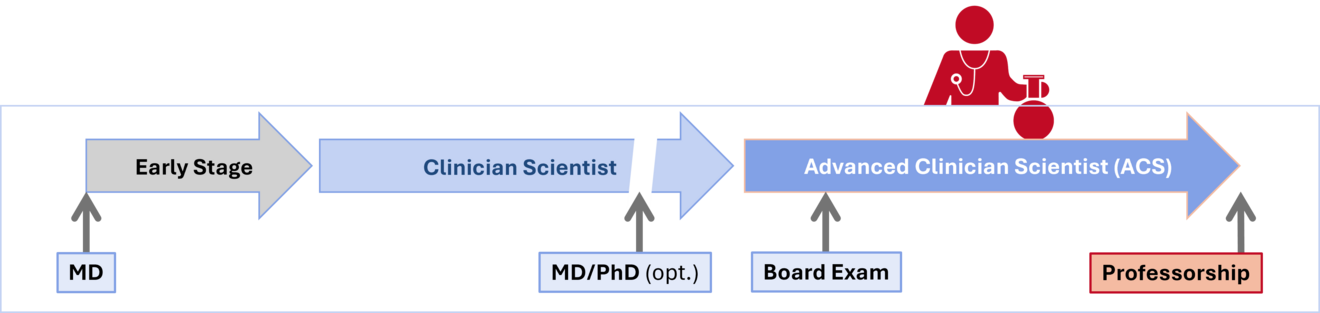
ACTIVATE addresses a crucial gap in the strategic framework of the University Medical Center Mainz (UMC) by focusing on the career progression of clinician scientists post-residency. By establishing the ACS program, clinicians will be supported along the whole career chain from the early phase of MD thesis support up to senior group leader and professorship.
Annual calls for applications will be issued during the program’s first four years and applicants will be selected in a two-stage selection process.
Program Idea
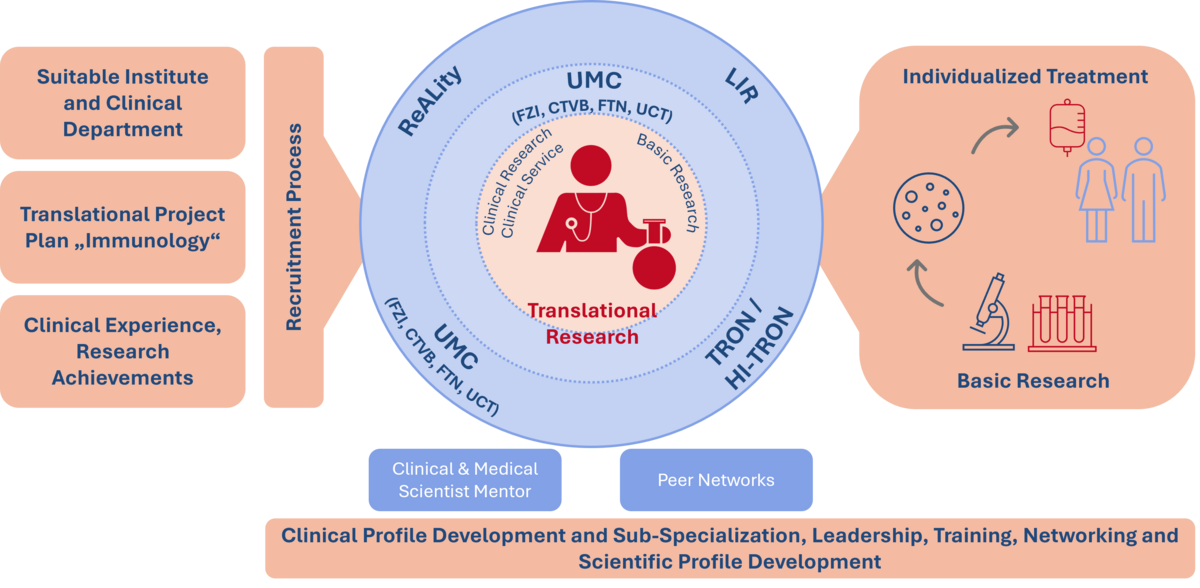
ACTIVATE Fellows lead independent, disease-oriented research programs that integrate laboratory investigation, clinical research, and patient care within 50% protected research time. The remaining funds can be utilized strategically for: Advancing independent research program, securing third-party funding, hiring and retaining staff, building national and international collaborations.
Their work is embedded in an established network of collaborating academic and translational research partners across multiple centers in Mainz, and they may undertake rotational placements at these institutions to deepen their scientific exposure. Fellows are appointed as ACS group leaders with guaranteed laboratory and office facilities, together with prioritized access to specialized infrastructure, technologies, and core resources.
Admission to the program requires affiliation with a suitable host institute and clinical department, a coherent translational research proposal in an immunology-related field, and a documented record of clinical experience and scientific achievement. Each fellow is supported by a personalized qualification and mentoring framework, anchored by senior clinical and scientific mentors and complemented by structured peer exchange.
Progress is formally reviewed at interim and pre-tenure stages. The UMC is committed to expanding sustainable career pathways for ACS through the creation of new professorial chairs, therefore all ACTIVATE Fellows will be integrated as principal investigators within the TRANSMED program.
The independence of ACS is fostered through several core mechanisms: autonomy in allocating research funds, the freedom to conduct research activities in optimal environments outside their clinical departments, and the flexibility to engage with diverse research institutions within or beyond UMC. This autonomy enables the ACS to establish independent working groups distinct from their clinical roles, positioning them as future leaders who will drive innovation within clinical departments. It is critical that the status of the ACTIVATE ACS is recognized as equivalent to independent group leaders, irrespective of clinical rank or seniority. The ACTIVATE Fellow’s independence will also be reflected externally through publications as senior authors on projects they direct.